PPM Chapter 11 - Fuel Policy Flight Planning
PIC responsible fuel at departure is in accordance with Part 121 and 121 MOS, and AIP
Departure (flight commencement) is defined as leaving the bay
Fuel Planning Requirements
PPM 11.1.1
Must consider:
- Anticipated or known weight of the aircraft,
- NOTAMS,
- Meteorological reports / forecasts,
- ATC procedures, restrictions, delays,
- Maintenance items and their effects, config deviations,
- Potential for deviations from planned flight due unforeseen factors
PPM 11.1.1
PPM 11.1.5
PPM 11.1.7
PPM 11.1.8
PPM 11.1.9
PPM 11.1.12
Normal Saab fuel consists of:
- Taxi,
- Trip (flight / block fuel):
- Takeoff + climb
- Cruise
- Descent to approach point
- Fuel for landing
-
Contingency / var res,
- Must not be less than 5%, or 5 min at holding speed 1,500ft above destination aerodrome in ISA
-
Final / reserve,
- 30 min at holding speed 1,500ft above destination aerodrome in ISA at estimated weight on arrival at destination alternate aerodrome, or destination aerodrome when no alternate required
- Must remain intact
- IAP,
- Holding,
- If holding for RAIM outages, apply 30 min buffer to commencement time, and sufficient holding or alternate planned
- Fuel is calculated at max altitude of FL200
- Alternate,
- No alternate :
- Fly 15 min at holding speed 1,500ft above destination aerodrome in ISA
- May be considered as Fixed Res
- Not needed to be considered when determining MIN FUEL or MAYDAY FUEL
- Takeoff alternate:
- Takeoff from departure
- Climb and cruise to alternate
- Descend and conduct approach
- Land at takeoff alternate
- Destination alternate:
- Perform missed approach
- Climb and cruise to destination
- Descend and conduct approach
- Land at destination alternate
- If two destination alternates - the fuel used is for the aerodrome that requires the greater amount of destination alternate fuel
- No alternate :
- Additional
- In the event of an engine failure or pressurisation failure, enough additional fuel must be carried to enable aircraft to proceed to alternate airport, fly for 15 min at holding speed at 1,500ft in ISA, make approach and landing
If not able to uplift all for flight, you may depart to suitable point of in flight replanning, or point of no return and then to destination, or to alternate airport
Note
With TEMPO - if alternate is available within 60 min and payload of TEMP would be restricting, carry alternate fuel
Fuel Monitoring
PPM 11.1.14
Once flight commenced, PIC must check fuel remaining is at least sufficient to complete the flight and includes:
- Trip fuel for remaining flight,
- Contingency / var res,
- IAP,
- Holding,
- Destination alternate,
- Final / fixed res
- Additional fuel
Must check:
- Not less once per sector flights less 90 min
- Not more than 60 min for flights greater 90 min
- When aircraft diverts from intended route
- When aircraft returns to intended route
MIN FUEL - all adequate airport options have been reduced to destination aerodrome, and any chance may result in arriving less than fixed res
MAYDAY FUEL - calculated FoB upon landing at nearest aerodrome where a safe landing can be made is less than planned fixed res
Point of In Flight Replanning
PPM 11.1.15
Determined before flight commences, intended so the aircraft can:
- Get to that point, complete flight to intended destination while maintaining the below FoB, or
- Get to that point, divert flight to intermediate aerodrome while maintaining the below FoB
Fuel required from point of in flight replanning:
- Trip fuel for remaining flight,
- Holding,
- Destination alternate,
- Final / fixed res
- Contingency,
- Additional fuel
Note
Intermediate aerodrome may be the departure aerodrome
Must not be used when departure / intermediate aerodrome requires an alternate (11.16.6), the destination is below the destination alternate minima (11.16.8)
Point of No Return
PPM 11.1.16
PNR or PLSD must be completed if FoB is not sufficient to allow the flight to continue from the intended point of landing (destination or alternate) to an alternate airport
Must not proceed unless in flight assessment of weather / traffic is made, and FoB is sufficient to advance
If past PNR/PLSD and FoB to alternate airport isn't sufficient, must declare min fuel
11.2 - Fuel Loading and Management
Must record and verify FoB on EFL before commencement of flight
If fuel is uplifted from location where Rex doesn't have system of fuel quality control, must check for presence of water / contaminates BEFORE and after uplifting fuel. If route manual indicates fuel is available at primary airport, consider that it meets quality control standards. If fuel is available but not listed in route manual, above requirements apply.
Captain is responsible to ensure fuel has been drained and checked
If check returns water, keep draining until samples are clear. If persists, contact engineering. If significant quantities of water are found, fuel system will need to be checked for water and removed (including fuel filters)
Note
Fuel must not be uplifted from drum stock without approval of GMFO / CP and CAM
Location of Aircraft for Refuelling
PPM 11.2.5
Must be at least:
- 5m sealed
- 6m stationary aircraft
- 15m exposed public area
- 15m unsealed building
Where refuel equipment is not mobile, ensure aircraft is positioned so it can be rapidly moved to place of safety
11.3 - Fuel Tankering
Must consider:
- Icing / turbulence with heavy weights
- Do not tanker more than round trip
- Minimise from outports
- Don't do at detriment of payload
When uplifting fuel at outport which results in difference b/w FoB and min fuel greater than 100kg, must state reason on EFL
When fuel is available for return / intermediate leg and payload is likely to be restricted by return / intermediate FoB, estimated fuel burn (outbound) should only include taxi and block fuel, so as to maximise return payload (which might require fuel at outports)
11.4 - Refueling with Pax on Boad
Considerations:
- Not permitted when overwing refuelling
- Must advise FA when commencing and stopping
- Pax must be informed fuel will be loaded, seatbelts must not be fastened, not smoke, operate electrical equipment, and inform when fuelling is complete
- No smoking sign on, seatbelt sign off
- Doors must be open, and stairs
- Must keep areas that would be used for evac clear
- FA must remain on board stationed at FWD Entry door
- Remove any obstructions from aisles and exits
- Stop refuelling if vapours detected inside aircraft
Caution
Catering may occur during refueling, but not if pax on board
11.5 - Ignition Hazards
Must not have engines / radar units on during refuelling
Ground power may not be connected / disconnected while refuelling underway
Must not use mobile within 15m, EFB within 3m of filling / venting points, fuelling equipment
11.6 - Fuel Spillage
If fuel quantity likely to cause a fire hazard is spilled within 15m of aircraft or fuelling equipment:
- Suspend fuelling, notify ARFF / local fire service
- Must not recommence or start engines until hazard removed
- PIC must ensure:
- Pax must be moved at least 15m away
- GPU / tugs / any other power unit shut down within 15m
- Maintenance work on aircraft must be suspended
11.7 - Flight Planning
Note
If Ops are unable to submit flight plan, PIC may use OzRunways or in accordance with Flight Planning Manual - with approval of ops
Briefing Material Required
- Head office, area, local, FIR NOTAMS
- GNSS / RNP Integrity
- Enroute / terminal weather forecasts (including alternates)
- NOTACs
Weather Material Required
Not more than 1 hr before flight, PIC must study weather reports for:
- The Flown Route:
- GAF area forecast for operations below A100,
- SIGWX for operations above A100,
- Flight forecast,
- Wind and temp forecast
- Aerodromes (Departure / Destination / Alternates):
- Weather forecast for aerodrome that has a useable IAP for this operation,
- GAF AND weather forecast for aerodrome that doesn't have useable IAP for this operation
- Any other relevant weather info
Must be valid 30 min before, 60 min after planned ETA
If unable to obtain wx forecast before departure and PIC considers weather conditions at departure will permit safe landing within 1 hour, may depart and return after 30 min if wx forecast for destination aerodrome is not obtained
Flight Planning
Need NAVLOG for each flight
Note
If destination TAF / METAR indicates conditions are below alternate minima, review the AWIS. If conditions are below the landing minima, can only depart with NOC approval.
When planning, consider the following:
- Wind - smooth levels that result in shorter flight time. Better to reduce flight time at expense of higher fuel burn
- Temp - warm upper level reduces performance. Lower levels in ISA Plus conditions are usually more appropriate, smooth flying dependant
- Weight - affects performance, must consider
- Cloud Tops / Icing Levels - avoid
- Turbulence - avoid
- Safety Height - must be able to maintain LSALT with critical engine inop, or depressurised
- Cruising Levels - in accordance with AIP
- Remote Island - only authorised within 200nm of mainland Aus, Tas, Torres Strait Islands
- Remote Area - consider
- Polar Operations - not allowed more than 78° North, 60° South
Sydney Curfew Planning
PPM 11.9
Flights before start of curfew that may be delayed (due weather, traffic, etc) and would land after curfew will need to divert unless dispensation obtained or emergency declared.
Unless dispensation and is operationally acceptable, PIC must plan for alternate when scheduled ETA of flight plus delays (weather / traffic) extend beyond 30 min prior to start of curfew.
Alternate fuel carried must be additional to promulgated traffic / holding fuel requirements
11.11 - Performance Limited Takeoff
Must give ops early advice when payload is operationally impacted by takeoff or landing restricted by performance considerations (rather than structural)
When it is known the next sector will be performance weight limited, inbound crews should advise ops / company agent via radio
11.12 - Offloading Payload
If needing to carry additional fuel at expense of payload, discuss decision with NOC
PPM 8.13.3
Where limitation requires offloading, offload in the following order:
- Red tag/standby baggage
- Company Freight
- Seek volunteers for baggage offload (voucher as incentive)
- All commercial freight (Excluding Australia Post “Gold” freight in QLD and livestock)
- Revenue Sub-load Pax (recreational staff travel - E class travel)
- Non-Revenue Sub-load Pax baggage (staff OCB)
If more than 3 bags are still required to be offloaded, consider offloading passengers before proceeding to number 7
- Rex Net fares baggage (T, L, N & O class)
- Rex Saver Fares baggage (K, H, Q & V)
- Y class baggage
- B class baggage
- Pax has a Rex connection baggage
- Pax has Domestic Connection baggage
- Australia Post “Gold Freight” (QLD only)
- Pax has an International connection baggage
- Pax has a disability and mobility aids
- SES essential baggage (NSW) / Priority baggage paid for
- Livestock
Note
Crew must not commit the Company to any arrangements regarding offloads unless approved by management.
The Company Directors, COO, GMFO and relocating operating crew must not be offloaded under the above provisions.
PPM 8.13.13
Blue Offload Bags - 5 bags stowed under last row. FA must give bags to any pax who need to remove items from any last minute offload baggage. When such passengers re-board, the pilot at the base of the stairs or the Flight attendant is to ask each individual to confirm that they have no sharp objects, weapons or dangerous goods as they board. FA must submit trip report (Date, A/C rego, Flight No., and Passenger’s name)
Captain Responsibilities
The Captain has the prerogative to require the offload of baggage regardless of the circumstances. the decision of the Captain is final and no person in the Company, including executive management, has authority to override that decision. The Captain should ensure an inspection of the seat areas occupied by transit passengers who fail to re-board an aircraft is conducted. Any items left on board shall be offloaded.
PPM 5.14.5
If a passenger fails to board, or is removed from the aircraft, they must have their checked baggage removed from the aircraft as well. There are no exceptions to this rule.
11.13 - Airport Operating Criteria
Airports are classified as:
- Primary:
- An airport covered by the AOC and contained in the route manual Ch 2
- Meet the requirements for all airport categories
- Alternate:
- Listed in route manual Ch 3
- Can be nominated on flight plan when required
- Meets the requirements for Adequate and Emergency Airports
- Adequate:
- Not listed in route manual
- Must meet requirements of CASA dictionary part 1:
- 30m min runway width, 90m min graded strip width
- Runway / taxi / obstacle lighting
- Pavement concession strength
- Meets the requirements for Emergency Airports
- Emergency:
- Reasonably expected to land safely in an emergency which there is immediate risk to safety of aircraft and pax
- Physical characteristics are related to the nature of the emergency, determined by the PIC
RPT ops must be conducted to / from primary airport. Does not restrict the use of alternate or adequate airports for use of alternates however. Primary and Adequate must be certified or military, or CASA has authorised ops there. For engine out operations, operationally suitable airport is all of the above. All rex flights are permitted to operate to and from airports without rescue and firefighting services
Night ops however must be conducted from an aerodrome for which there is an:
- IAP procedure,
- Available nav aid (including GNSS),
- Obstruction lighting where necessary
When considering continuation of flight to other than the destination aerodrome, PIC must consider:
- Reason for diversion and impact on safety,
- Weather / approach aids,
- Performance limits,
- Crew familiarity with airport,
- FoB and availability of fuel at airport,
- Engineering assistance,
- Pax handling and transport options
11.13.1 dictates the criteria for airport classification
11.15 - AEO and OEI Thresholds
AEO - must not fly over water at a distance greater than what the aircraft could reach land if the critical engine was innop, except for takeoff and landing. All flights greater 50nm from land suitable for emergency landing shall be equipped with life jacket or flotation device for each occupant. Must not fly further from an adequate aerodrome than the distance the aircraft can fly OEI in ISA for 60 min
- A Model - 178 IAS (198nm)
- B Model - 189 IAS (204nm)
- WT Model - 187 IAS (208nm)
11.16 - Alternates
| Relevant Minima | |
|---|---|
| Cloud | More than SCT below the relevant minima |
| Vis | Less than the relevant minima, or probability of 30%+ |
| Wind | More than maximum for aircraft, including gusts |
| TS | Thunderstorm or associated severe turbulence, or probability of 30%+ |
Cloud Math
Few + Few = SCT
Few + Sct = BKN
Sct + Bkn = BKN / OVC
Change Indicators
If BECMG, assume bad weather starts at beginning of becoming period, or better weather starts at end of period
Probability Indicators
If forecast includes 30-40% chance that weather conditions will satisfy the relevant minima, the wx conditions are taken to be present
Does not apply if the forecast is a TAF3 and the ETOU is fully encompassed w/i the first 3 hours of the validity of the forecast
Estimated Time of Use
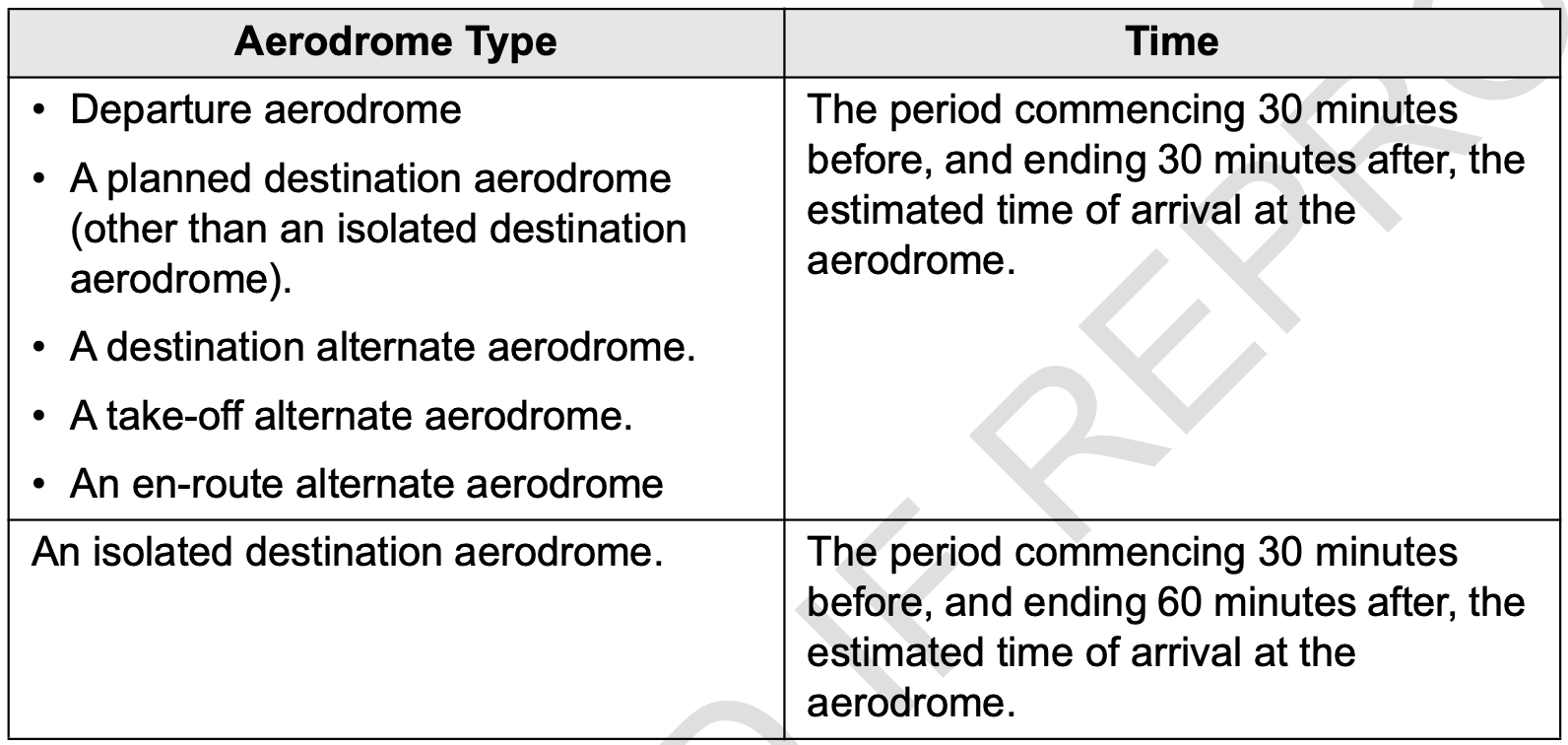
Approach Capability
Alternate required if an instrument approach is required and the aircraft is not equipped to conduct and IAP because failure in aircraft or ground navaid
Note
IAP required if cloud ceiling below last segment LSALT + 1000ft, vis below 8km
11.16.5 - Take Off Alternate
Take-off alternate required if relevant weather is forecast at departure aerodrome, or not possible to land for other reasons
The alternate aerodrome must be available, within threshold distance, have forecast indicating relevant weather isn't present during ETOU, permit safe operation of aircraft considering operational limits and met conditions
Note
Wx 30-40% of INTER or TEMPO can be disregarded when considering wx for selecting take-off alternate aerodrome
11.16.6 - Destination (Alternate Minima)
Alternate required if relevant weather is present at destination.
| Relevant Minima | During ETOU: |
|---|---|
| Cloud Ceiling | 1,000ft abv landing minima for IAP most likely to be conducted 500ft abv min circling alt if into-wind runway approach cannot be performed |
| Vis | Greater of 5km, or if IAP will be used, 2km greater than IAP vis |
Despite the above, you can use the minima in 11.16.8 if:
- in flight within 60 min for intended landing,
- available forecast is TAF3 and the validity is encompassed in the times below
- Wx isn't below minima specified in 11.16.8
- from 30 min before ETA
- until 60 min after ETA
- no known ATS delays that would require carriage of holding fuel that is not already carried:
- beginning from ETA
- ending 60 min after ETA
Two alternates are required if relevant wx is forecast at destination during ETOU, or wx forecast is not available (or not avail FULLY during ETOU). Only one is required however if relevant wx is not present at DESTINATION ALTERNATE, and cloud ceiling / vis is above 11.16.6
11.16.8 - Additional Requirements (Destination Alternate Minima)
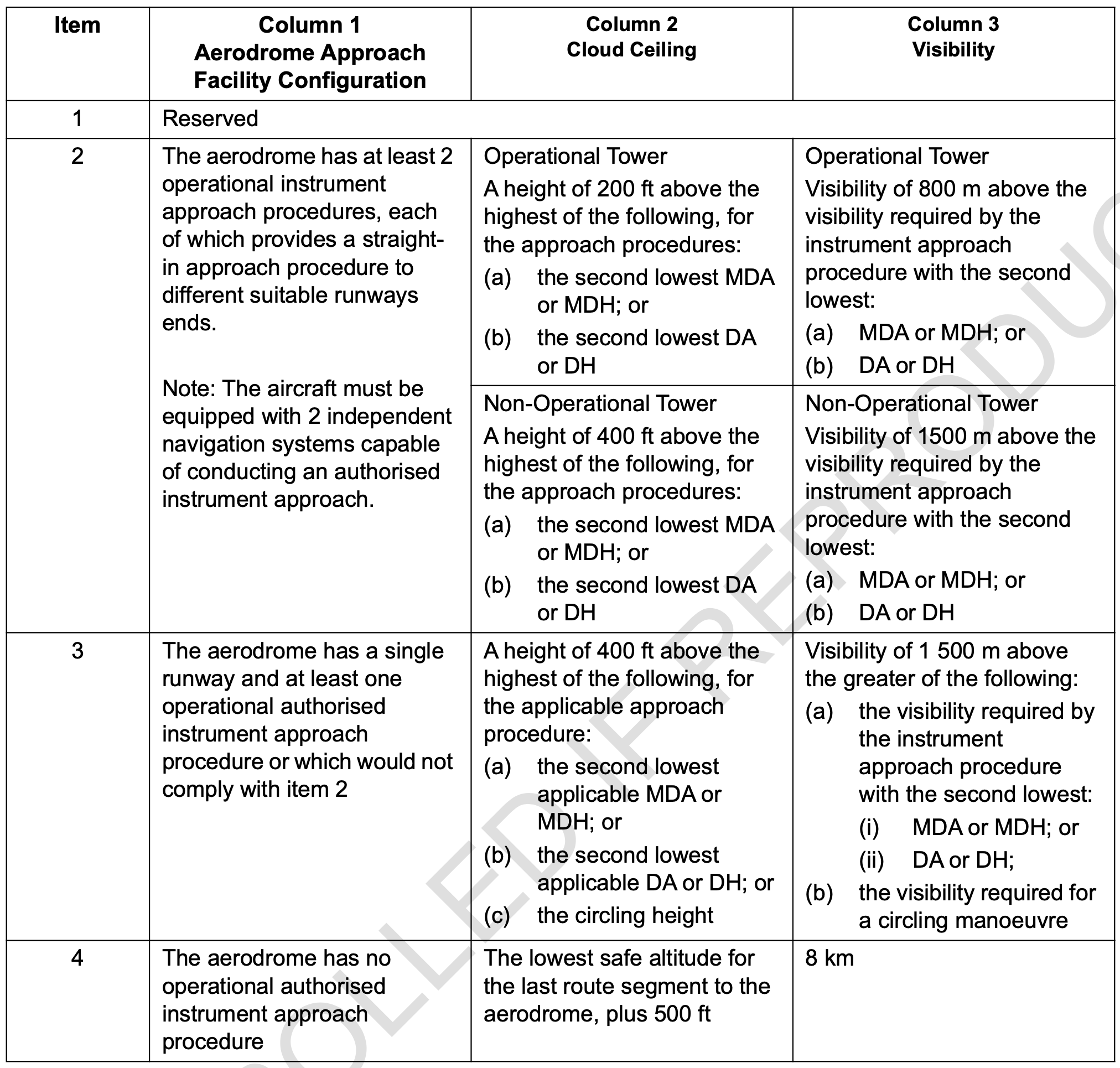
Using GAF
If forecast used is GAF / GAMET, the aerodrome may be used as a destination alternate or en-route alternate only if relevant weather is not present during ETOU:
- for aerodrome with IAPs, the relevant weather is:
- cloud - circling min alt on the IAP, plus 500 ft,
- vis - circling vis on the IAP, plus 2km
- for aerodrome without IAPs:
- cloud - last segment LSALT + 500ft,
- vis - below 8km
11.16.10 - Lighting Requirements
If only portable lighting, or lighting with no standby power, need alternate unless:
- someone is there and able to deploy portable lighting from at least 30 min prior to ETA and until finished taxiing or first light plus 10 min, or
- holding fuel is carried to enable holding until first light plus 10 min
If PAL lighting with standby, need alternate unless:
- someone is there and able to enable the lighting from at least 30 min prior to ETA and until finished taxiing or first light plus 10 min, or
- holding fuel is carried to enable holding until first light plus 10 min