PPM Chapter 12 - Saab SOPs
12.4.2 - Briefings
Brief the FA on:
- Flight times
- Expected en-route and terminal weather
- Expected turbulence that may affect initiation / continuation of cabin service
- If refuelling with pax on board will be required
- MEL's that may affect the FA
- Current NOTACs
- Any other aspect that might impact the FA
If encountering turbulence, make PA to pax to explain why in-flight service is suspended
PAs shouldn't include specifics of failures, refer to indication failures as "indicator or sensor malfunction". Keep pax informed, but avoid creating unwarranted anxiety / concern.
Note
The fasten seat belt sign must be on:
- During take-off and landing,
- During an instrument approach,
- When the aircraft is flying < 1000 ft AGL
- All times in turbulent conditions.
Note - a captain may give a taxi brief where appropriate, referencing the intended use of taxiways, wingtip clearance, apron strength, prevention of jet / prop blast.
Debriefing Following Abnormal / Emergency Operation
PPM 12.4.5
Must debrief as soon as possible after flight. All crew must attend, even if this were to delay duty on another aircraft.
Discuss the incident honestly and comprehensively, and in a manner to alleviate any apprehensions the crew might have.
Encourage questions from the crew.
12.5 - Jumpseat
Ch 5 lists authorised persons
All approved persons must have appropriate identification (doesn't have to be ASIC)
Note
Fare paying pax are not permitted in jump
12.5.3 - Sterile FD
- Begins from engine start checklist until 10,000ft
- From 10,000ft to shutdown checklist
- Within 10,000ft assigned alt / APA
- Climbing icing conditions or with residual ice accumulation
- Climbing in VS mode
FA No Contact Period
- Takeoff - from application T/O power until landing gear retracted
- Descent - landing gear extended until landed and off the runway
- RTO - until brought to a stop and Captain PA has been made
First Officer Takeoffs and Landings
PPM 12.6.9
PPM 12.12.7
- Captains should conduct all abnormal landings unless not doing so increases safety
-
FOs must not land in the following conditions until 600 total flight hrs, 300 hrs on aircraft type, and for night, 20 night hours with 20 night landings on type:
- Any landing with an LDA < 1300m
- X-wind component in excess of 18 kts (half allowable x-wind limit)
- Landing where wind speed > 30kts
Night
- Landings with LDA < 1500m
- Any landing with a runway w/o slope guidance
- Night circuit / circling approaches unless at a capital city aerodrome
The route manual may vary the above conditions
Should place hands / feet on controls lightly
The CPT is responsible for ensuring that they conduct any landings where it is deemed unsafe for the FO to continue flying. CPTs must be pilot flying for the first 40 sectors atier being checked to line.
CPTs should conduct any landings with an abnormality, unless it is deemed safer to delegate this to the FO.
First Officer Restrictions
FOs must not complete the following until they’ve logged 600hr total flight time including 300hr on type:
- Landings on runways with LDA less than 1300m
- Crosswind landings in excess of 50% aircraft crosswind limit (17kt)
- Landings where wind speed exceeds 30kt
Additionally, first officers must have completed 20hr flight time at night including 20 night landings on type before conducting:
- Night landings on runways with LDA less than 1500m
- Night landings on runways without slope guidance
- Night circuit or circling approaches unless at a capital city aerodrome
12.6.13 - Standard Calls
General Calls
| Condition | PM |
|---|---|
| AoB > 30° | "Bank angle" |
| HDG exceeds ±5° (±20° OEI) |
"Heading" |
T/O Calls
| Condition | PM |
|---|---|
| Pos RoC not maintained | "Sink rate" |
| ASI falls below V2+5 (AEO) Likely to exceed a limiting speed |
"Speed" |
Instrument Approaches
PM must monitor instruments for gross disparities. Applies until 100ft abv threshold height (even if visual before minimums)
| Condition | PM |
|---|---|
| Level flight ±100ft | "Altitude" |
| Speed +10kts or -5kts from target | "Speed" |
| ILS LOC > half scale deflection | "Localiser tracking" |
| ILS GS > half scale deflection | "Glideslope tracking" |
| VOR/FMS CDI > half scale deflection | "Tracking" |
| NDB > ±5° | "Tracking" |
| DME ARC > ±2NM | "Tracking" |
| Below 1000ft AGL, VS > 1000fpm | "Sink rate" |
| More than 1 light high/low on T-VASIS/PAPI | "Slope" |
Where practical, call current altitude deviation every 2NM, and required height at the next 2NM point. At 1500ft, call every 1NM until the approaching minima call
Speed call must be made if approaching limit, trending away from target, or reduction below VFA
12.6.15 - Collision Avoidance
Use the APA, set 1000ft vertical separation
12.6.19 - Emergency Operations below Meteorological Minima
Emergency landings are permitted at airports below meteorological minima where necessary to land in the interests of safety
12.6.20 - Special Flights
Diversion of RPT flights for SAR purposes is only permited with GFMO approval. Mercy flights may be conducted only with company approval. Crew should not engage in requests for assistance where doing so may put the safety of the aircraft at risk or there are alternative agencies which can provide the same service.
12.6.28 - Wildlife Avoidance
- Maintain constant lookout whilst taxiing
- Give good scan before T/O inhibit timing etc
- If required, taxi along runway to disperse wildlife
- Consider RTO if strike is experienced below 80kts
- Do not alter T/O procedures / profiles in attempt to avoid wildlife between 80kts and 500ft
- If bird strike is encountered short final, recommended not to go around
- Avoid reverse thrust after strike
Refer PPM 13.12 for more procedures
12.6.29 - Crew Incapacitation
May be subtle, use SOPs to reduce risk of going unnoticed. If one or more crew members indicate symptoms of food poisoning, consider possibility of additional crew becoming incapacitated.
12.6.30 - Continuation of Flight OEI
May proceed to alternate aerodrome or continuation of flight after considering:
- Nature of malfunction, possibilities of mechanical difficulties which may be encountered if the flight is continued
- Nature and extent of any city / town / area over which the aircraft is to fly (water?)
- Availability of the inop engine
- Alt, weight, FoB
- Distance to be flown
- Weather conditions
- Aerodromes available for landing (familiarity?)
- ATC congestion
12.7.3 - TAWS
Must report all spurious warnings in maintenance log, including:
- Alt,
- Rad alt,
- Speed,
- RoD,
- Position
12.7.4 - Use of AP/FD
Note
During coupled IAP or when below 1500ft AGL, keep hands / feet on controls
12.7.6 - Failure Nav Lights
If noticing any nav lights have failed, PIC must notify ATC, consult MEL. If the light is not MELable, and cannot be repaired, notify ATC and land when possible without danger.
12.8.7 - VHF Communications
Controlled - monitor company before airways clearance (approx 10 min before start), then monitor SMC freq on 1, company on 2
Circuit join calls are required. Base and final recommended. For straight in approaches, make call at joining final at 5NM, and 3NM if possible
Entering / backtracking broadcast required. Airborne broadcast (including intentions) is required if turning contrary to circuit direction.
Company SAR on departure lasts for 15 min. Network ops will be contacted if arriving 15 min after ETA
Try to contact company before 60NM with (as applicable):
- ETA,
- Fuel requirements,
- Any unserviceability,
- UMs, pax requiring assistance, time critical connecting pax
If ETA to company changes by more than 5 min, provide updated ETA
12.8.11 - TIBA
Refer PPM
12.8.12 - PAs
On short sectors, brief announcement can be made prior to start or take off. On flights > 90 min, make 2 PAs (unless pax asleep), one being prior to descent.
Note - don't blame ATC for delays, refer traffic congestion, runway constraints, noise abatement requirements, weather etc
12.8.12 - RCS
Need beepback unit or company manual readback.
If RCS not available, ops can continue for seven days.
Must advise ops if AFRU not available or intermittent, submit SMS.
If arriving/departing from airport that was towered, but delays prevented operations during towered times, no requirement for RCS
12.9.2 - FMS
FMS database is updated every 28 days. If discrepancy b/w FMS and AIP, follow AIP
12.9.5 - Distress or Urgency Communication
PIC determines what call is made:
- Mayday - aircraft / pax / crew are threatened by serious and or immediate danger requiring immediate assistance
- Emergency descent
- Smoke in the cockpit
- Uncontrolled fire
- Structural failure
- Loss of control
- Urgency (Pan) - condition concerning safety of aircraft, or someone onboard / ground, but does not require immediate assistance
- Pan Medical Priority Required - specify additional services required (ambulance / paramedic / etc), ATC will not provide any
12.12.3 - On Time Departures
Scheduled departure time is beacons on time. Can use discretion to delay flight for late pax. Consider:
- Expected arrival time at destination,
- Connecting pax,
- Aircraft flow after arrival,
- Probability of late pax showing,
- Weather changes at destination.
12.12.4 - Early Departures
Must not leave more than 5 min before COBT, or scheduled departure time, whatever is later. Must contact ops for early slot time if PIC sees fit due delays enroute, curfew requirements, etc.
12.12.5 - Boarding
Major hubs - boarding 15 min prior to departure.
Reopening of Aircraft Doors
After closed, they cannot be opened without specific approval of the captain.
12.12.6 - Engine Start
Don't start unless following has been completed:
- Remove flammable material within 15m,
- All hatches / doors locked, area clear, adjacent space available on apron,
- Aircraft positioned at least:
- 5m sealed building
- 8m another aircraft
- 15m from exposed public area
- 15m from unsealed building
- Shall not be operated when aircraft, refueling or public area that lie to the rear and within 15° arc either side of the exhaust outlet of that engine:
- Turbo Prop -
- Slow taxi (15m)
- Initiating taxi with power (23m)
- Turbo Jet -
- Slow taxi (30m)
- Initiating taxi with power (46m)
- Turbo Prop -
12.12.11 - Taxiing
Make all turns below 20kts, being mindful of proximity of obstacles and the effect of thrust.
Make with largest radius as possible (to avoid side loads and unnecessary scrubbing of tires)
Can use differential power, good in crosswind conditions
Aim to leave the nosewheel straight when stopping (i.e. after a turn, return nosewheel straight and roll forward a bit)
In strong wind, always hold into wind. Operate engines at higher RPM when taxiing downwind to avoid exhaust gas ingestion into cabin. Consider turning off bleed air.
Always set park brake when coming to a stop
Advise ATC if unable to follow a clearance for whatever reason (something blocking path etc)
12.12.14 - External Lights
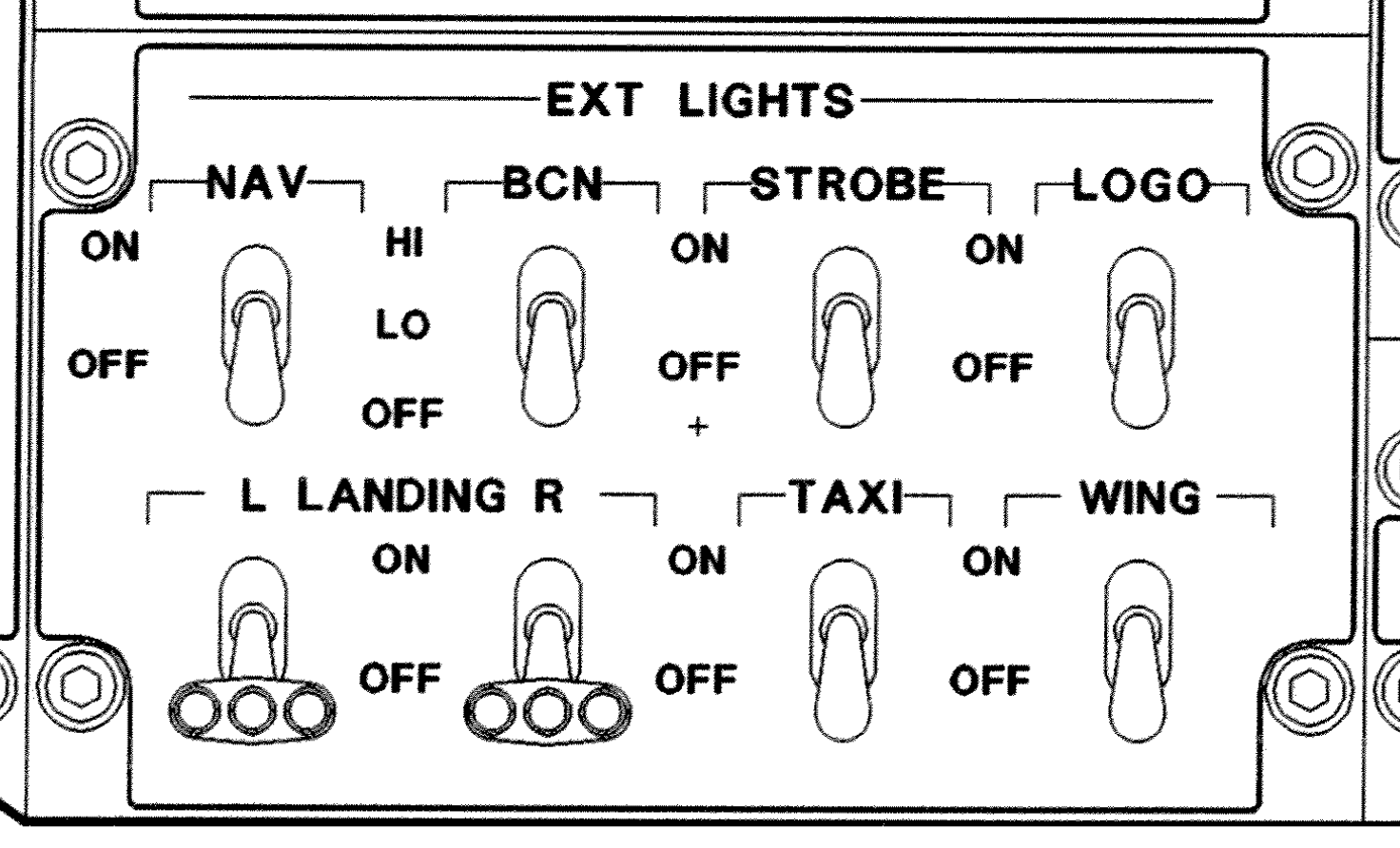
| Requirement | |
|---|---|
| Nav | Nav lights on when at night or conditions poor vis |
| Beacon | Starting (HI prior to entering any runway) |
| Taxi | On as required, or when clearance is obtained to line up for takeoff / before entering any runway |
| Strobe | With clearance to line up for takeoff, or before crossing, entering, backtracking on any runway May be turned off when in poor vis / glare, or after landing and clear of the runway |
| Landing lights | on when cleared for T/O (CTA) or commencing T/O roll (OCTA), or all times below 10,000ft. Turn off after landing |
Before Start - Nav as required, Beacon
Before Taxi - Taxi as required
Crossing RWY - Taxi, Strobe, Beacon HI
Cleared L/U - Taxi, Strobe, Beacon HI
Cleared T/O - Landing Lights
12.12.15 - Weather Radar
When operating on ground, beam must be clear of following by at least 37m (120ft) of:
- Aircraft being fulled,
- Fuel tankers, tanks, storage area,
- Persons or cargo,
- Other aircraft / hangers
IF beam stationary, must increase to 60m (200ft)
Warning
Do not monitor radar during T/O roll, only after aircraft is established in climb
12.13.3 - Flight Instrument Monitoring
PM must monitor all instruments positively until 500ft PF must observe V speeds on takeoff, PM call is backup only
12.13.6 - Crosswind Considerations
PIC must consider:
- Runway:
- Width
- Length
- Conditions (wet/loose/etc)
- Gust factor / turbulence encountered on departure path
- T/O power setting
- Braking action
- Xwind limits
12.13.8 - Turns After Takeoff
Avoid banking abruptly below 500ft
If necessary and likely to cause pax apprehension, make PA
12.13.9 - Cabin Signal
Min 1,500ft and above MSA
12.14.3 - Nav Logs
Always note 'set heading time' and calculate ETAs
On flights greater than 30 min, complete Nav Log section of the flight plan at each waypoint
12.14.4 - In Flight Contingencies
If unable to continue in accordance with ATC clearance, attempt to obtain revised clearance. If circumstances prelude prior clearance:
- Broadcast intentions on 121.5
- Divert 90° to L/R whenever possible
- Climb / descent to intermediate levels
- Attempt to establish parallel track in either direction displaced by 25nm
- Advise ATC of circumstances
12.14.7 - Diversions Due Weather
Select port with maximum facilities for handling, plus accommodation for pax (particularly at night).
12.15.3 - Cabin RoD
Max 500fpm for pax comfort
12.15.8 - Cabin Secure for Landing
The 5 min chime gives the FA 2 min to be seated and secure.
Must not descend below 1000ft or commence an approach until secure
12.16.6 - Cat 1 Approaches
DA 300ft - Vis 1200m or greater = first groups of approach lights / cross bars should be visible. Remaining approach / cross bars should come into view, threshold lights not visible until 250ft
DA 200ft - Vis 800m or greater = three cross bars extending outward from threshold should be visible at the minima. Threshold lights may not be visible immediately, should come into view within seconds. Threshold must be in view if approach lighting U/S
12.16.8 - Stabilised Approaches
Constant angle / RoD ending near the touchdown point.
Should be stabilised from the FAF for RWY aligned IAPs, 300ft all other cases
Stabilised when maintaining these down to the landing flare:
- On speed, slope, track
- Proposed landing config (bar flap 35 to 500ft)
- RoD < 1000fpm
- Power setting appropriate
- No more than normal corrections to maintain correct track and profile to touchdown zone
Bank angle should be less than 15°
RoD less than 2000fpm below 2000ft, 1000fpm after FAF / below 1000ft if visual If procedure requires > 1000fpm past FAF, brief as required
12.16.10 - Visual Approaches
Landing lights / anti col lights / strobe lights must be illuminated when less than 5nm from aerodrome
Use of VASIS angles greater than 3.5° may cause increase in runway length rollout
Make sure turn to final completed by 500ft AGL, 5nm
12.16.15 - Runway Aim Point
Use slope guidance until 250ft AGL, transition to aiming point
300m aiming point (start of middle touchdown zone marking)
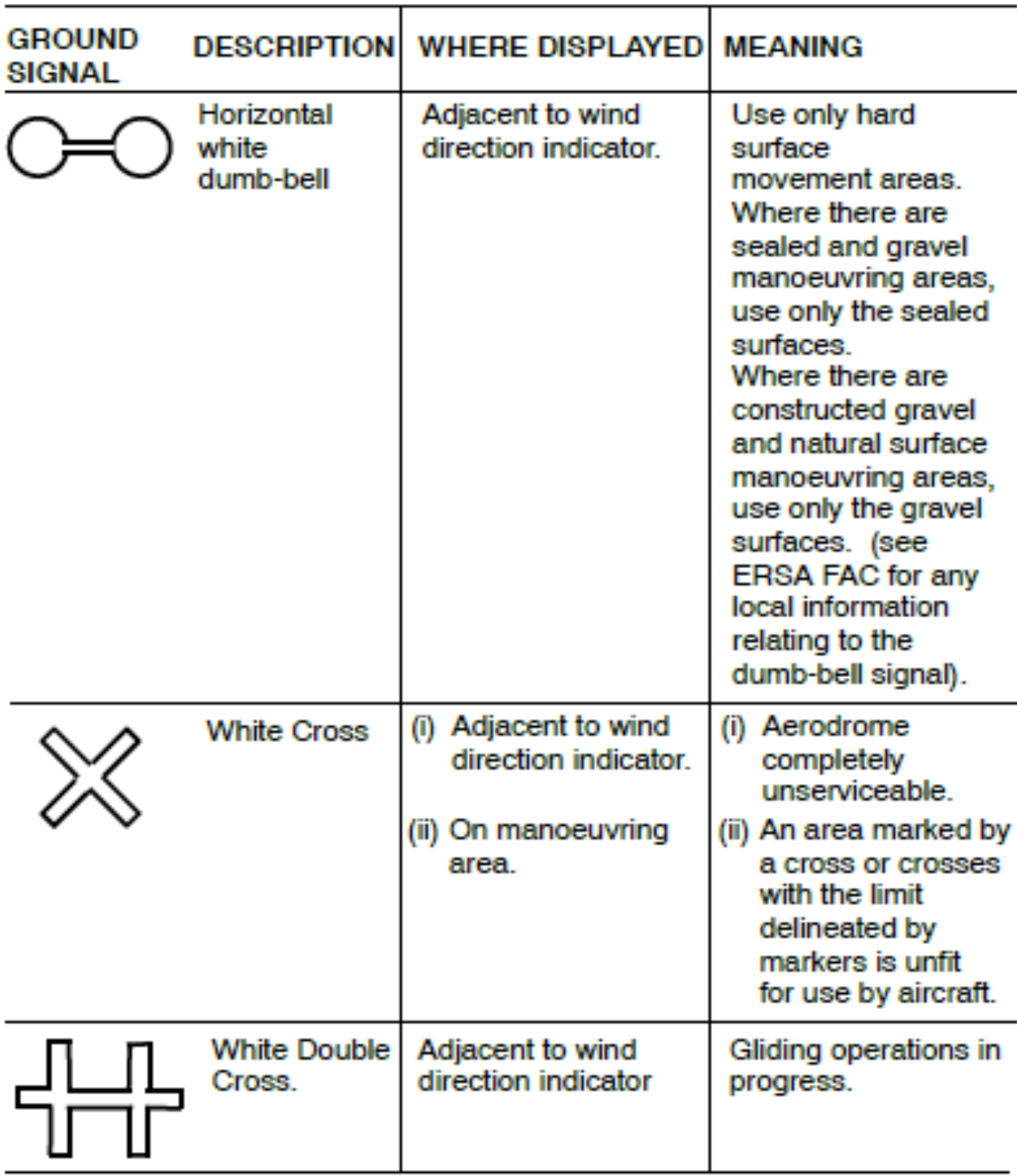
12.16.17 - Ground Signals to Aircraft
12.17.5 - Tailwind Considerations
Avoid where practicable. PIC must consider:
- Tailwind component,
- Landing WT,
- RWY length avail / required,
- Traffic,
- Prevailing Wx,
- Wear / tear (brake usage),
- Company procedures
12.17.6 - Touchdown Areas
Acceptable area - 150m position to 450m position
Do not touchdown before 150m position, permitted to land beyond 450m depending on the aiming point used and RWY length.
12.17.9 - Landing on Wet Runways
Caution
If advised RWY encompasses SWS areas, consider moving pax from rows 2 and 3 for takeoff or landing. Operations on unsealed RWY classified as SWS are not permitted
12.17.10 - After Landing and Parking
Monitor surface movement control (SMC) until after shutdown
Caution
Uncommanded movement when parked (e.g. weather cocking / rolling / rotating) must be reported to engineering
Extended Parking
When parked overnight / extended period during the day in an unsecured area, secure the aircraft. If left unattended at non-capital city for extended period of time:
- Lock aircraft, controls locked, park brake on, wheels chocked
- Park in well lit area overnight if possible
- Pitot / intake covers, prop ties
- Park into wind, controls locked, park brake on, wheels chocked if winds > 20kts
Airport staff will lock plane as per above, must lock if no staff present.
12.18 - Passenger Disembarkation
Note
DPLs cannot be used when wind speeds exceed 40kts (consider this when accepting DPL at port)
12.18.1 - Rapid Disembarkation
Captain should determine if L1 door is adequate to disembark all pax depending on the severity of situation and number of pax on board. Pax need to leave baggage on board.
Procedure:
- Time permitting, cap contact FA and brief them on plan of action
- Cap make PA 'Rapid Disembarkation' from QRH
- FO guard prop and evacuate, direct pax to safe area, monitor pax for no smoking or phones
- FA stay at station, in case captain needs to relay more info
- Cap can upgrade the rapid disembarkation to emergency at any time, if doing so, leave stairs in current position
- Once all pax evacuated, FA will check no remaining pax. Cap then disembark after FA with pax manifest to ensure all pax accounted for
Examples for normal disembarkation:
- Abnormal situation where safety of pax and crew are not in jeopardy
- Small amount of smoke is evident from engines after start, but dissipates after shutting down, no evidence of dire
- Warning within certified protected time or in contact with on site fire commander
12.19 - Reporting Defects
FA must submit a trip report if referring any item to captain (including PA handset issues)
12.20 - Turn Arounds
Rush / Hurry are NTS keyword (don't rush or hurry)
Consider the following for turn arounds:
- Weather,
- Time on ground,
- Pax numbers,
- Baggage,
- Staff availability (other flights / airlines / still at check-in)
12.21 - Adverse Weather
Below 1000m vis, LHS pilot should be designated unless PIC deems it's safer otherwise
Below 800m vis, only one aircraft / vehicle can manoeuver on the ground at uncontrolled aerodromes, and:
- Maintain high SA (through EFB, radio, etc)
- Additional broadcasts for traffic awareness,
- Terminate taxi if unsure of position,
- Follow me vehicles,
- Don't enter RWY unless verbal confirmation that vehicles / aircraft are clear
Flight Encountering Hail
- Reduce to min speed, as with turbulence,
- Lower seats in case windscreens fail,
- Be prepared for decompression / emergency descent, instrument / system failures
- Once clear, visually check aircraft for damage. Consider faster IAS if aerodynamic surfaces damaged
- Configure early, monitor control response
- Land nearest suitable if airworthiness compromised
Radar
Avoid sharp changes in intensity:
- BLW 10,000ft - 5NM (10NM if OAT below 0)
- 15,000 to 20,000ft - 10 to 15NM
-
ABV 20,000ft - 20NM
-
Can travel through weak echos / areas of gradual gradient
- Periodically check greater ranges to see the extent of the storm and for additional developments
- When lining up, set tilt to determine best possible climb out path
12.21.6 - Turbulence
Consider:
- Forecast of turbulence,
- Wind strength / direction,
- Mountain wave activity,
- Proximity of cumulonimbus clouds
If turning on seat belt sign due turbulence, once FA is seated, captain must make PA advising normal cabin service will cease
If entering known areas of mechanical turbulence and strong winds on the ground, consider reduction of speed below 15,000ft, or before descent through cloud tops is recommended
- Shoulder harness, flight deck lights to bright, monitor instruments
- Correct speed
- Maintain constant attitude, don't chase IAS or ALT, avoid turns
- Avoid overcorrecting, power alterations (unless limits are exceeded)
Reporting
Advise ATC, and CTAF if uncontrolled
Length:
- Occasional - less 1/3 time,
- Intermittent - 1/3 to 2/3 of the time,
- Continuous - more 2/3 time
Type:
- Moderate - moderate changes in attitude and/or altitude, aircraft remains in control. Small variations in IAS exist. Difficult to walk, feel strained against steatbelts. Loose objects move about
- Severe - abrupt changes in attitude and/or altitude, may be out of control. Large variations in IAS. Feel forced violently against seatbelts. Loose objects tossed about
Landing on Wet, Icy, Slippery Runways
Warning
Do not land on these runways with xwind, only do so in an emergency
12.21.7 - Flight in Icing Conditions
Worst near cloud top and in extensive altostratus with temp around -5°
When entering icing conditions, consider the following:
- Aircraft ice systems,
- Consider actions with regards to LSALT and FRZ LVL,
- Observe ice build up, monitor IAS,
- Prepare pax for noises / vibrations associated w/ ice shedding,
12.21.8 - Windshear
Change of wind speed and/or direction.
Severe - IAS changes greater 15kts, or VSI greater 500fpm
Presence of windshear indicated by:
- TS activity,
- Virga,
- Pilot reports,
- Low Level Windshear Alerting System
Takeoff Precautions
Consider the following if winshear is suspected on takeoff:
- Rated power,
- Longest suitable RYW, or RWY that has headwind increasing with altitude,
- Be alert for ASI fluctuations on climbout (usually first indications of windshear), maintain good lookout,
- Use lower flap setting for improved performance,
- Consider improved climb takeoff speeds,
- Use normal rotation speeds,
- Know AEO pitch climb attitude,
- PM should be across normal values of instruments, monitor closely, esp at night
If encountering after TO:
- Apply max TQ limit, or if necessary forward power lever limit
- If encountering near VR and IAS suddenly decreases, may not be enough RWY to accelerate back to VR, rotate normally at least 600m from the end even if ASI is low. Higher than normal attitudes may be required to lift off.
- Unusual control column pressures may be required to maintain desired pitch angle. Respect stick shaker. Disregard FD and fly to pitch limit for stick shaker guidance.
- On climb out, don't accelerate back to normal climb speed. If above stick shaker, slowly pitch up to trade off speed for improved climb capability until altitude loss can be prevented
- Don't change gear / flap config until vertical flight path is under control
- Don't make stab trim until stable conditions
- Be prepared for additional shear areas
Landing / Approach Precautions
- Min flap (20° recommended)
- Add speed as required (below 800ft, use stabilised approach speed not more than 20kts above VREF),
- Avoid large power fluctuations until beginning of flare,
- Cross check FD commands using vertical flight path instruments,
- PM should be across normal values of instruments, monitor closely, esp at night
- If encountering shear below 800ft and results in unacceptable flight path deviations, go around. Increase to avoid terrain at normal rate, to initially towards 18°. Don't change config until vertical flight path is under control and ground contact no longer a factor.
Note
- May need more than 18° to avoid terrain
- In all cases, the pitch attitude that intermittently sets off stick shaker / buffet is the upper pitch limit
- Large power increases may result in nose-up pitching tendency requiring forward column pressure / elevator trim
12.22 - EFBs
80% at sign on, can drop to 50% during duty
Data input is allowed when stationary and park brake set, or during low workload periods when abv 10,000ft or cruising below 10,000ft
12.23 - Smoke, Fumes, Odours Protocol
Communicate odors
- Oil - Sweat, locker room, dirty sock, burning rubber, sour milk, mild irritation to eyes
- Hyd Fluid - Strong irritation to eyes, pungent, acrid
- Electrical Faults - Acrid, burning rubber, sulphur
Protocol
- Refer QNH if applicable,
- Contact Ops if able, ATC if required
- After landing, Cap and FA contact Ops. Asses impact of event on fitness to operate. If any doubt, don't operate.
- SMS (safety report + WHS) / AML / Rex smoke, fumes, odours report
- If experiencing any of the following, advise ops and seek medical assistance:
- Coughing, wheezing, shortness of breath,
- Sore / burning throat, difficult swallowing, nasal irritation, chest pain
- Dizziness, headaches, weakness
- Nausea, vomiting